July 9, 2025
Crypto Payments in Switzerland: How Lugano is Normalizing Daily Adoption
Explore how Lugano is setting a new standard for crypto payments, where digital assets move seamlessly from wallet to checkout in one of Europe’s most advanced markets

In most of the world, using crypto to pay for everyday goods is still unusual. In Lugano, it’s not.
Walk through the city center, and you’ll find POS terminals at restaurants, gelato shops, bookstores, and pharmacies that accept digital assets alongside Swiss francs. From public services to private retail, crypto payments are working across categories, not as an experiment, but as part of the city’s infrastructure.
At the center of that shift is Lugano’s Plan ₿ initiative, a public-private partnership backed by the City of Lugano and Tether, with NAKA providing payment infrastructure across the merchant network.
It wouldn’t be an exaggeration to call it a living ecosystem.
A Local Economy with Crypto Access
Switzerland has long been seen as a hub for crypto development, with strong financial regulation, technical talent, and favorable legal frameworks. But Lugano is where crypto is moving from the back office to the checkout counter.
A good example of how this is being implemented at the city level is the Plan ₿ initiative. Launched in early 2022, Plan ₿ is a public-private initiative aimed at bringing blockchain-based payments into everyday life. Today, over 400 merchants in Lugano accept Bitcoin (BTC), Tether (USD₮), and LVGA (the city’s own CHF-pegged stablecoin). These include coffee shops, clothing stores, public service counters, clinics, and grocery chains. Even the local McDonald’s accepts crypto.
If it’s not quite clear in how many places crypto payments can be used in Lugano, here’s an example: Mir Liponi recently made a no fiat challenge after her bank account got blocked, and even paid for her eye examination with BTC. Read the full story here.
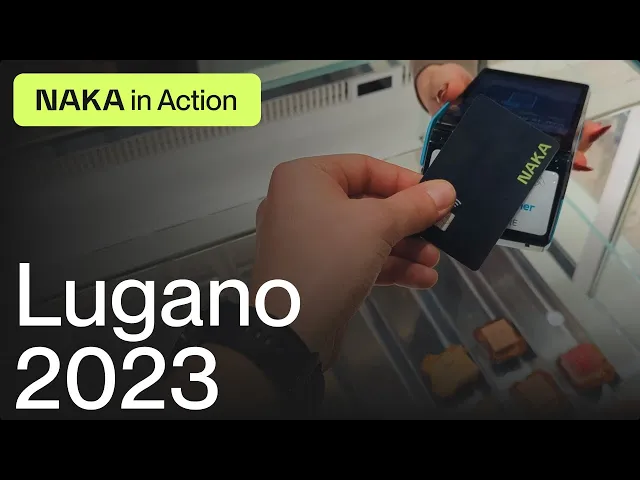
The Plan ₿ initiative uses the NAKA Payment Network to enable crypto payments across the city. Users can tap to pay using EMV cards (whether virtual or physical) connected to supported wallets, and merchants can receive settlement in stablecoins or fiat, depending on configuration. No additional staff training or process changes are required.
What the Numbers Show
The clearest spike in transaction activity came during the 2024 Plan ₿ Forum, where over 6,100 crypto payments were recorded in Lugano over two days, totaling approximately $160,000 in volume. These payments were made primarily in Bitcoin and Tether (USD₮), according to official reporting from Tether.
Outside of events, adoption remains steady. Plan ₿ reports over 400 merchants in Lugano currently accept digital assets. The city’s MyLugano cashback system has supported this growth, with LVGA used for thousands of purchases monthly, particularly in small retail and food service.
Zooming out to the national picture, Switzerland is one of the most advanced markets in Europe for crypto payments. In 2023, approximately 23% of Swiss residents reported owning digital assets, according to the Bitpanda study. But beyond ownership, what sets Switzerland apart is the integration of crypto into real-world commerce from retail and hospitality to public services.
Lugano is where this shift is most visible. It’s not just that people hold crypto, they’re spending it. Digital assets are circulating through standard payment infrastructure, in a city that treats them as part of its economy rather than a future concept.
Conditions That Enabled Adoption
Three areas contributed to the effectiveness of Plan ₿ in Lugano:
Funding
The city allocated over 100M CHF toward blockchain development, with 3M CHF earmarked specifically for merchant incentives and infrastructure deployment. This funding reduced barriers to entry and covered early operational costs.Clarity
Switzerland’s national regulatory position on stablecoins, DLT infrastructure, and digital asset classification allowed the project to move forward without ambiguity. Financial institutions could support settlement and compliance workflows without introducing new legal frameworks.Infrastructure
Terminal hardware, card systems, and merchant onboarding were managed in coordination with private providers such as NAKA. This allowed merchants to use tools and support systems they were already familiar with.
NAKA’s presence on the ground in Lugano included infrastructure deployment, merchant support, and participation in the Plan ₿ Forum, where the first live NAKA Card transaction took place in October 2023.
Commentary from the Ground
In a recent piece by NAKA’s Managing Director for Switzerland, Ajet Redžepi outlines how Swiss merchants are approaching crypto payments. His observations reflect a pattern: interest grows when the cost of acceptance drops, infrastructure is consistent, and customers begin to expect alternative payment options.
The merchants participating in Plan ₿ are not early-stage crypto adopters. They include small family-owned shops, franchise locations, and institutions offering services to both residents and tourists. Crypto is not positioned as a replacement for existing systems, it is simply an additional way to transact.
Lessons for Payments Infrastructure
Lugano is a functioning system where a digital asset economy operates across everyday transactions, backed by financial institutions, city government, and businesses.
For payments companies and institutions building in similar environments, several takeaways are clear:
Merchant activation is driven by simplicity. Hardware, support, and training must feel familiar.
Customers are more likely to pay with crypto when card-based systems are supported.
Stablecoins remain the most adopted asset for real-world spend, especially in regulated markets.
Integration with local services, not just retail, accelerates normalization.
Lugano demonstrates that crypto payments can become infrastructure when design decisions prioritize interoperability, merchant stability, and city-level partnership. With NAKA’s technology underpinning the transaction layer, the system works without demanding attention.
It operates the way payments infrastructure should: consistently, securely, and in the background.
If you’re interested in learning more about the NAKA Payment Network, check here.
Share this post